top of page


Insights
Our latest thoughts across the energy sector.
To play, press and hold the enter key. To stop, release the enter key.




Maryland’s First Storage Capacity Awards: What Round 1 Tells Round 2 Bidders
440 MW selected. Two projects. One clear lesson for developers: revenue certainty helps, but it is only the beginning. On October 1, 2026, the Maryland Public Service Commission conditionally selected two four-hour storage projects for Energy Storage Capacity Credits under the Next Generation Energy Act. Together, the projects represent 440 MW of potential storage capacity—55% of Maryland’s 800 MW Round 1 target. Key points: Benefit: each selected project is eligible for an E
Oct 65 min read


Power Inverters on the FCC Covered List
Photo: Dalton Huston-Bursaw / U.S. Department of Energy On July 28, 2026, the FCC's Public Safety and Homeland Security Bureau added foreign-produced power inverters — and advanced robotic devices — to the Covered List, implementing two National Security Determinations transmitted by a White House-convened interagency body the day before. Key takeaways Covered equipment cannot receive a new FCC equipment authorization, which is required before import, marketing, or sale. Auth
Aug 76 min read


U.S. Power Market Update: Q3 2025 Trends
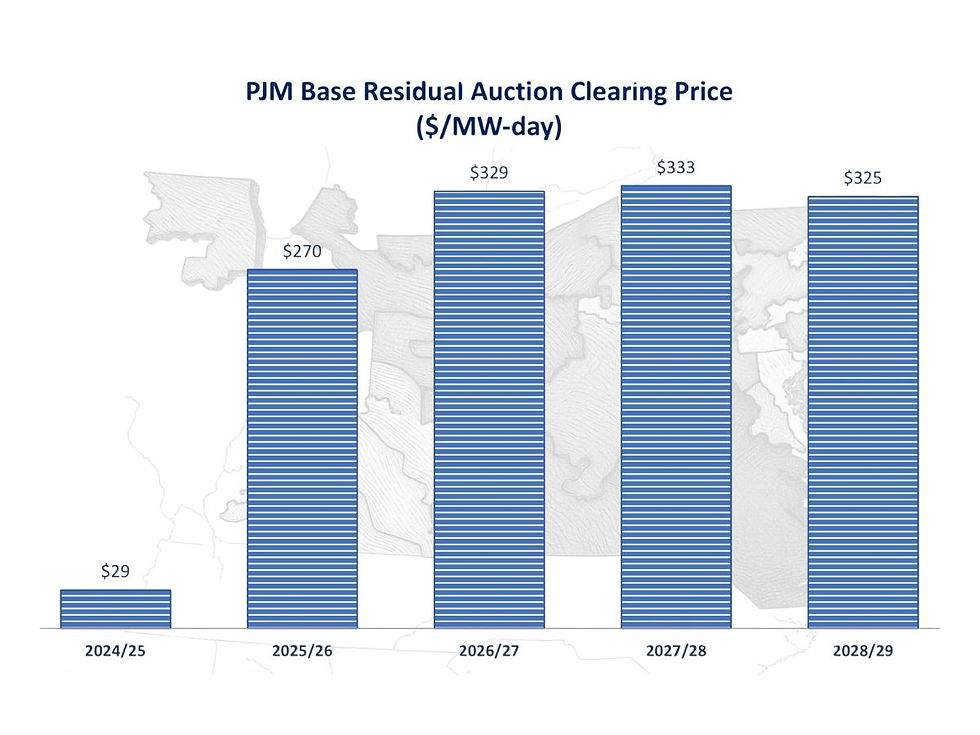
The U.S. power sector remains in a period of accelerated deployment and shifting signals. On one side, record solar additions are being realized — the result of projects financed under the Inflation Reduction Act from 2022 — extending a nearly two-year streak as the leading source of new power generation. On the other, interconnection data shows a power pipeline swinging back toward natural gas, driven by the structural pull of data centers requiring around-the-clock power. T
Sep 23, 20255 min read


Are Backup DERs Now Becoming a Part of the Grid’s Backbone?
Distributed energy resources (DERs) have long been seen as “backup” — assets that sit idle until an emergency strikes. But two recent milestones suggest that DERs are evolving into something much more significant: a dependable, everyday backbone of the modern grid. California’s DSGS Program: Scale and Value California’s Demand Side Grid Support (DSGS) program offers a clear example of how quickly distributed storage is scaling. In 2025, the program enrolled nearly 700 MW of r
Aug 21, 20252 min read


What Happens After EV Batteries Retire? Unlocking a Second Life
As electric vehicle (EV) adoption accelerates globally, a powerful secondary opportunity is emerging: a new source of scalable, distributed energy storage. The first wave of lithium-ion EV batteries is beginning to retire from automotive use. While these batteries may no longer meet the performance needs for driving, they are far from finished. Many still retain 60–80% of their original capacity — and that remaining capacity is opening the door to their second life. Instead o
Jul 31, 20252 min read


Power Up Your Home: A Case Study on the Value of Residential Solar and Battery Back-up
Electricity costs are on the rise, and power outages are becoming more frequent across the U.S. This trend is driven by surging demand on the power grid, largely due to the proliferation of data centers, particularly those supporting Artificial Intelligence (AI), and the increasing occurrence of extreme weather events. Residential solar panels paired with a home battery backup system offer a powerful solution for energy independence, cost savings, and reliable power. I. The E
Jun 27, 20255 min read


The Transitioning Role of Natural Gas
The U.S. grid is evolving — fast. One of the more interesting shifts buried in the latest U.S. Energy Information Administration’s June 2025 Short-Term Energy Outlook is how natural gas is increasingly playing the role of a balancing fuel, rather than a traditional baseload or pure peaking resource. At first glance, this may sound subtle. But the operational and market implications are significant. The Old Model For the last decade, natural gas — particularly combined-cycle g
Jun 16, 20253 min read


Understanding Solar Renewable Energy Credits (SRECs)
As solar energy expands across the U.S., understanding SRECs—Solar Renewable Energy Credits—has become essential for system owners and energy market watchers alike. In this quick guide, we break down what SRECs are, how they work, how much they’re worth in different states, and the key facts you need to know in 2025. WHAT ARE SRECs? Solar Renewable Energy Credits (SRECs) represent the clean environmental attributes produced by a solar PV system. 1 REC = 1 megawatt-hour (or 1
Apr 16, 20251 min read


Empowering Education: How Vehicle-to-Grid Technology Can Boost School Budgets
Historically, many schools across the United States have faced budget constraints that negatively impact the quality of education provided to students. In this article, we explore a promising solution that can prove to be an innovative source to boost school budgets. This solution involves transitioning from conventional Internal Combustion Engine (ICE) school buses to electric buses AND implementing Vehicle-to-Grid (V2G) technology. This approach leverages many of the federa
Sep 4, 20245 min read


The Practical Implementation of Virtual Power Plants (VPPs) in PJM
What is a Virtual Power Plant? (Source: https://www.energy.gov/lpo/virtual-power-plants-projects) Virtual Power Plants (VPPs) are an important part of the energy transition by aggregating distributed energy resources such as small solar and wind, along with storage options like batteries, into a unified virtual power plant. In doing so, they enable the real-time control and optimization that empowers these typically variable and distributed sources to act collectively as thou
Aug 28, 20242 min read


Understanding Low Carbon Fuel Standard Credits (LCFS): A Path to a Sustainable Future
The transportation sector has been among the largest contributors of Greenhouse gas (GHG) emissions (approximately 30% [1] ) in the United States, and the fastest-growing emissions source globally. Several federal and state policies aim to reduce GHG emissions from transportation. In 2006, CA passed AB32 creating the first Low-Carbon Fuel Standard (LCFS) program, which is one such program analyzed below. Total U.S. Greenhouse Gas Emissions by Economic Sector and Electricity E
Aug 15, 20247 min read
bottom of page