top of page


Insights
Our latest thoughts across the energy sector.
To play, press and hold the enter key. To stop, release the enter key.



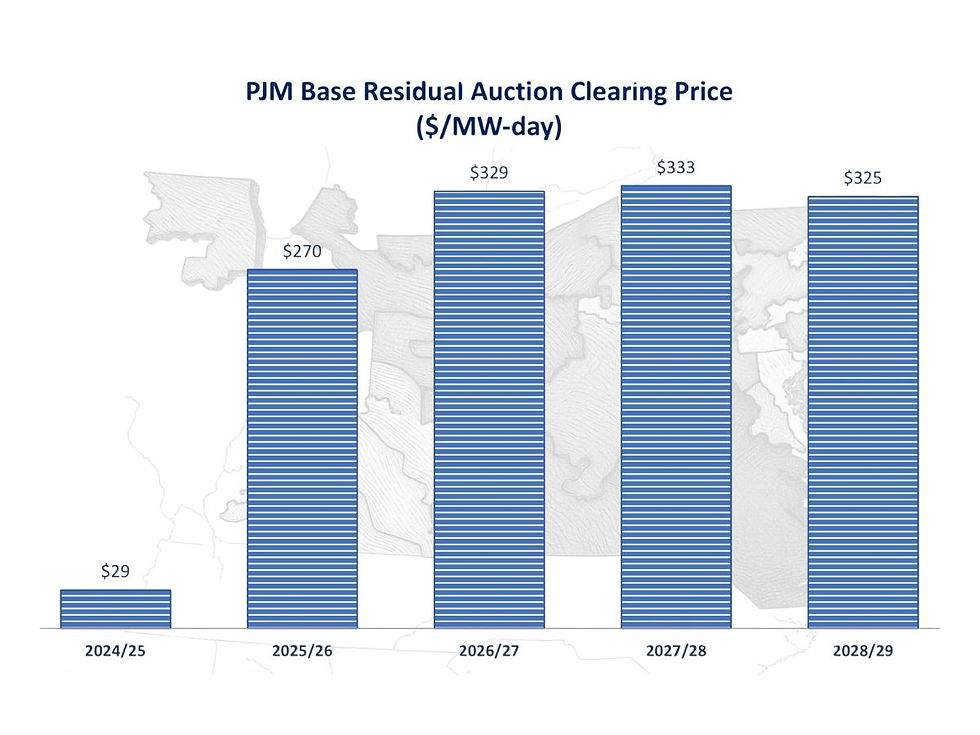



PJM's 2028/29 BRA: $325/MW-day price cap
PJM’s 2028/29 Base Residual Auction, announced on July 14, 2026, cleared lower than the prior auction while its supply shortfall widened. The lower price traces to the temporary cap; the widening shortfall reflects fundamentals the capped price does not express. Takeaways: PJM's 2028/29 Base Residual Auction cleared at a single RTO-wide $325/MW-day — the third consecutive auction at the FERC-approved cap. Number of constrained LDAs remained at zero, and there was no LDA-leve
Jul 166 min read


H1 2026 U.S. Power Market Update: Regional Responses to Rising Electricity Demand
In H1 2026, one theme came to define U.S. power markets: reallocation. As AI and data-center demand outpaced a delivery-constrained grid, the year turned less on adding capacity than on redirecting it — who pays for reliability, what provides it, and where the grid gets built next. PJM A capacity shortfall, a record grid bill, and a $67B merger PJM's capacity market reached its limits in H1 2026. The 2027/28 capacity auction cleared at its price cap yet still recorded the fi
Jul 86 min read


Diverging Paths: How MISO and ERCOT Respond to Rising Power Demand
Recent U.S. Energy Information Administration (EIA) Today in Energy reports highlight how different parts of the United States are responding to rising electricity demand in different ways. While both MISO and ERCOT are absorbing significant load growth, including demand from data centers, their generation mix responses continue to diverge. Coal remains competitive in MISO Coal-fired generation remains economically competitive in MISO. The latest EIA Today in Energy analysis
May 212 min read


Cybersecurity for Behind-the-Meter Platforms
Last month, six federal agencies jointly issued Advisory AA26-097A, confirming active exploitation of internet-exposed industrial control systems (ICS) across U.S. critical infrastructure. Threat actors logged into programmable logic controllers using legitimate engineering software, tampered with configuration files, and manipulated operator displays — causing measurable operational disruption and financial loss. On its face, the advisory targets bulk power assets covered by
May 85 min read


Data Centers and Behind-the-Meter Generation in PJM
In April 2025, we first discussed market trends related to the AI race and co-locating new large loads and behind-the-meter generation to solve timing issues involved with interconnection. Co-locating large data centers with dedicated power plants has been pitched as a way to beat PJM’s interconnection queue and secure firm, power for AI and cloud workloads. In practice, the story has been far more complicated. FERC’s December 2025 order on co‑located load is the first seriou
Jan 298 min read


Transmission Voltage Stagnation
EHV efficiency versus real-world constraints: the pros and cons of "right-sizing" the grid. The Hidden Cost of "In-Kind" Replacement In the world of transmission planning, the path of least resistance is often the one already traveled. When an aging 138 kV or 230 kV line reaches the end of its useful life, the default regulatory and operational impulse is often "in-kind" replacement—swapping old towers for new ones of the same voltage. The scope is a straightforward rebuild;
Dec 4, 20254 min read


Understanding Virginia’s Rising Electricity Prices
Residential electricity prices across the U.S. have been rising since 2021, and Virginia is no exception. According to the U.S. Energy Information Administration (EIA), Virginia's average residential electricity price stands at 16.01 ¢/kWh, up from 14.17 ¢/kWh a year earlier. This represents a 13% year-over-year increase and an approximate 30% rise from 2021 levels. While Virginia's rates remain slightly below the national average of 17.62 ¢/kWh, the Commonwealth is narrowing
Oct 31, 20254 min read


U.S. Power Market Update: Q3 2025 Trends
The U.S. power sector remains in a period of accelerated deployment and shifting signals. On one side, record solar additions are being realized — the result of projects financed under the Inflation Reduction Act from 2022 — extending a nearly two-year streak as the leading source of new power generation. On the other, interconnection data shows a power pipeline swinging back toward natural gas, driven by the structural pull of data centers requiring around-the-clock power. T
Sep 23, 20255 min read


Are Backup DERs Now Becoming a Part of the Grid’s Backbone?
Distributed energy resources (DERs) have long been seen as “backup” — assets that sit idle until an emergency strikes. But two recent milestones suggest that DERs are evolving into something much more significant: a dependable, everyday backbone of the modern grid. California’s DSGS Program: Scale and Value California’s Demand Side Grid Support (DSGS) program offers a clear example of how quickly distributed storage is scaling. In 2025, the program enrolled nearly 700 MW of r
Aug 21, 20252 min read


Snapshot: The U.S. Copper Supply Chain
With increasing global focus on critical minerals in the energy transition, copper remains a foundational material — essential, undervalued, and heavily relied upon across nearly every sector of modern infrastructure. From residential wiring to utility-scale transformers, copper plays a central role in keeping systems powered and connected. As regulatory pressures shift and the 50% tariff on imported copper approaches (set to take effect on August 1, 2025), it’s essential for
Jul 10, 20251 min read


The Transitioning Role of Natural Gas
The U.S. grid is evolving — fast. One of the more interesting shifts buried in the latest U.S. Energy Information Administration’s June 2025 Short-Term Energy Outlook is how natural gas is increasingly playing the role of a balancing fuel, rather than a traditional baseload or pure peaking resource. At first glance, this may sound subtle. But the operational and market implications are significant. The Old Model For the last decade, natural gas — particularly combined-cycle g
Jun 16, 20253 min read


Three Advantages of Co-Locating New Load and Power Generation
In recent months, several large-scale energy projects have been announced in which developers are co-locating large electrical loads with power generation assets. While this model offers clear strategic benefits, it also raises technical and regulatory questions that stakeholders are actively working through—from grid interconnection processes to environmental permitting and commercial strategies. To illustrate the benefits of co-location, consider the following key advantage
Apr 8, 20251 min read


PJM's Fast-Track Interconnection Process Has Attracted 94 Applications Totaling 26.6 GW
PJM Interconnection’s one-time Reliability Resource Initiative (RRI) has drawn strong participation, with 94 proposed projects totaling 26.6 gigawatts (GW) of nameplate capacity. This fast-track application window was created to address PJM’s urgent reliability needs and accelerate the development of grid-ready resources. According to PJM’s filing with the Federal Energy Regulatory Commission (FERC), the initiative aims to bring at least 10 GW of capacity online 1.5 years ear
Mar 27, 20251 min read


Why Transformers Matter
"The massive growth in data centers will require what is called three-phase, dry-type transformers… the growth in public electric vehicle (EV) charging stations will require additional three-phase, oil-immersed transformers. And building electrification and at-home EV charging will require significant up-sizing of single-phase transformers.” — Killian McKenna, Researcher, National Renewable Energy Laboratory (NREL) As the pace of electrification accelerates across the U.S.,
Mar 24, 20252 min read


3 Takeaways on U.S.–Canada Power Flows
Electricity trade between the United States and Canada plays a quiet yet crucial role in maintaining grid reliability across North America. While it represents less than 1 % of each country’s total generation, its strategic importance continues to grow. Here are three key insights: U.S.—Canada electricity trade is less than 1% of each country’s total generation The U.S. net electricity import has been narrowing in recent years driven by droughts and lower U.S. natural gas pri
Mar 13, 20251 min read


PJM’s AI Power Puzzle: Why PJM Matters in the AI Energy Revolution
PJM Interconnection – the deregulated power market in the U.S., serving 65 million people across 13 states and D.C – has emerged as the global epicenter of AI-driven electricity demand. In 2024, PJM Peak Load was 152 GW. It represents 20% of total US electricity demand and its Dominion zone is the corridor to 70% of global Internet traffic. Part 1: PJM’s Top 3+3 Zones Driving 59 GW Surge PJM’s 2025 load forecast released January 24, 2025, reveals 59 GW of new AI/data center d
Feb 6, 20252 min read


The Practical Implementation of Virtual Power Plants (VPPs) in PJM
What is a Virtual Power Plant? (Source: https://www.energy.gov/lpo/virtual-power-plants-projects) Virtual Power Plants (VPPs) are an important part of the energy transition by aggregating distributed energy resources such as small solar and wind, along with storage options like batteries, into a unified virtual power plant. In doing so, they enable the real-time control and optimization that empowers these typically variable and distributed sources to act collectively as thou
Aug 28, 20242 min read
bottom of page